1.5M+ customers · Blueprint adopted company-wide
Set the frontend standard at a 1.5M-user Bitcoin wallet.
Xapo was a global Bitcoin custody and multi-currency wallet platform. The architecture and tooling I introduced became the company's frontend standard.
Overview
Xapo was a fully remote global fintech providing multi-currency digital wallets and Bitcoin custody to over 1.5 million customers worldwide. I joined as a senior frontend engineer in November 2017 and stayed through April 2020.
What I worked on
I worked across the wallet’s layout and several of its core surfaces — the account view, the debit card, settings, and the send-money flow — in a product built for a global audience in English, Spanish and Portuguese.
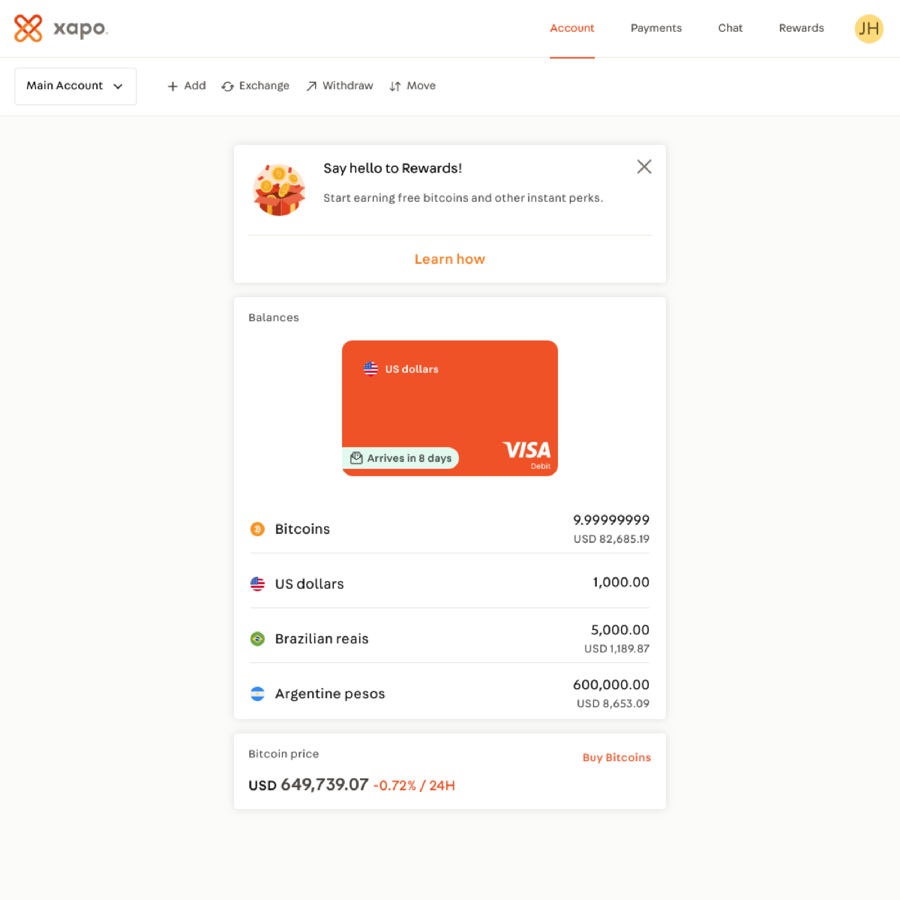 The account layout: bitcoin, US dollars, Brazilian reais and Argentine pesos in one place, with the debit card and rewards inline.
The account layout. The home of the wallet — bitcoin and local currencies side by side, each converting to a reference currency in real time, with the debit card and rewards surfaced where people would see them.
A bitcoin-native debit card. A Visa debit card funded straight from the wallet, so a balance held in bitcoin or local currency could be spent anywhere.
Send money, any way. I built the Send flow that handled every rail from one screen — a bitcoin address, a bank transfer, a saved contact, or stablecoins.
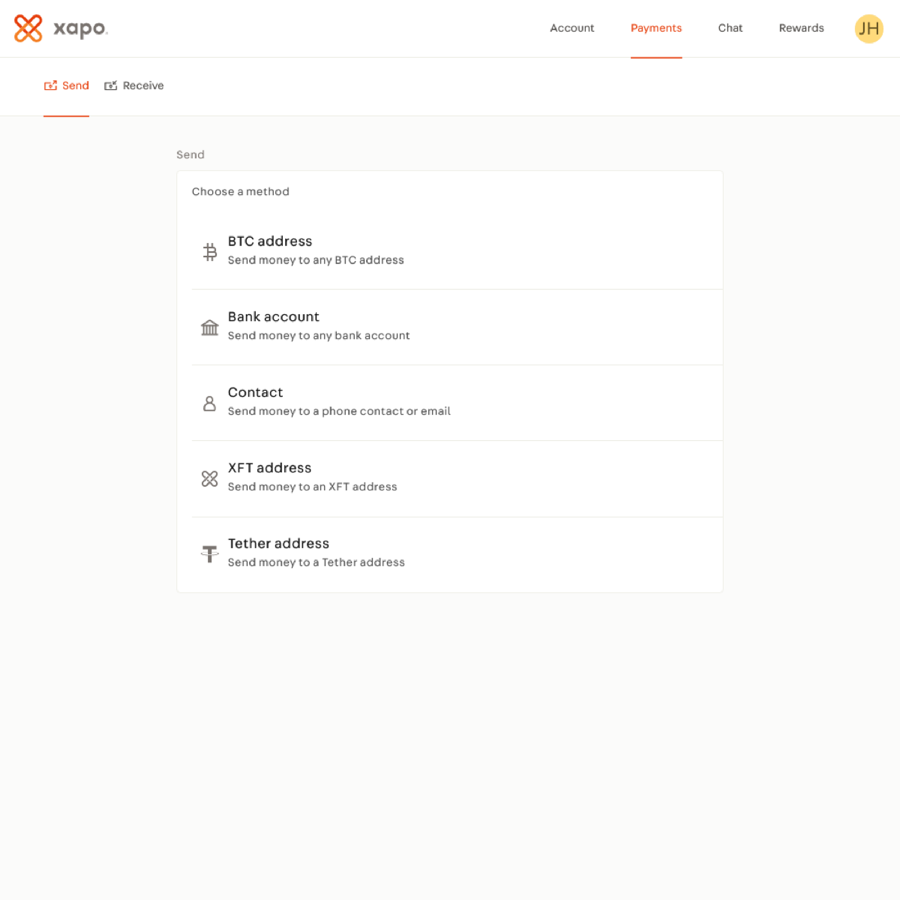 One Send flow, several rails: bitcoin, bank account, a saved contact, and stablecoins.
Settings and profile. Identity-verification status, account management, notifications and security — the unglamorous surfaces a money app lives or dies on.
Chat, and People Nearby. An in-app chat let people send payments inside a conversation, and a People Nearby tab helped users find each other to swap cash for bitcoin and back — peer-to-peer, well before that was common.
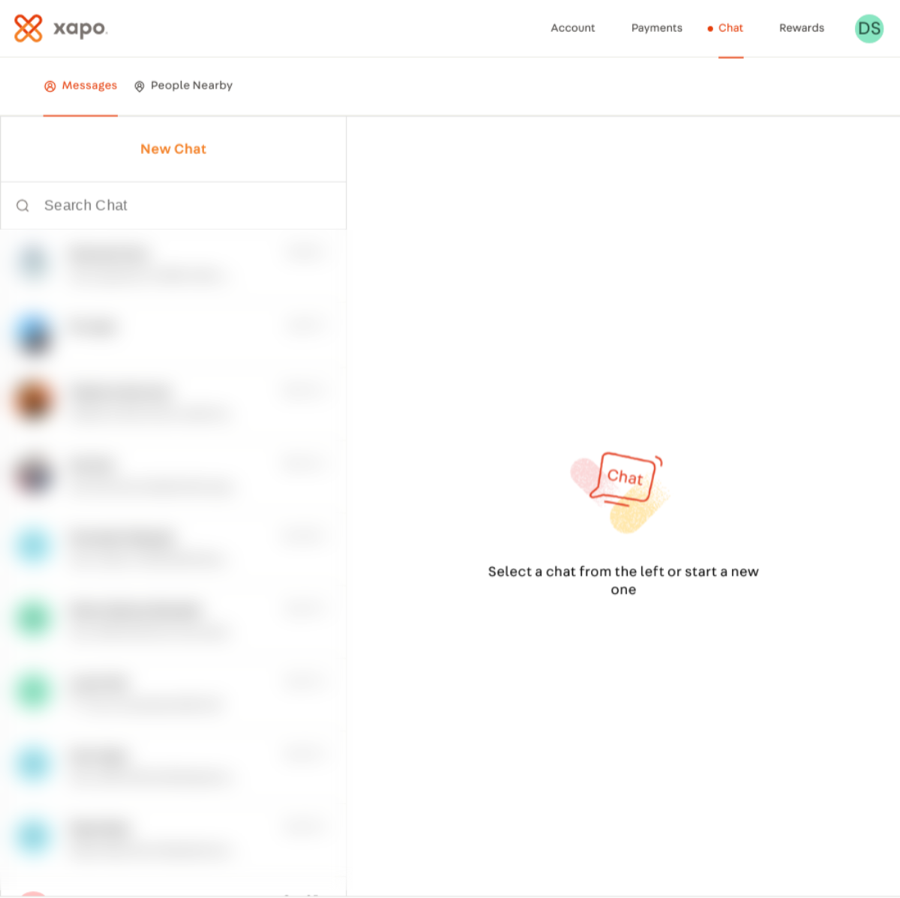 Chat and People Nearby: send money in a conversation, or find someone to swap cash for bitcoin. Names blurred.
Multi-currency, multi-language. Customers in Argentina and Brazil held pesos and reais next to their bitcoin, in their own language.
The Vault. Beyond the everyday wallet, the Vault moved bitcoin into deep cold storage — kept offline in a former Swiss military bunker, the feature Xapo was best known for.
The problem
The frontend teams were building product against different stacks, with no shared architecture, no shared CI, and no shared testing baseline. Every new product surface meant re-deciding the basics. That slowed delivery and made cross-team review difficult.
What I built
Chapter 1 — The architecture blueprint
I designed a full-stack application blueprint — React, Next.js and Express — that became Xapo’s company-wide engineering standard, adopted across multiple product teams. The blueprint included a server-rendering pattern, conventions for state management, an HTTPS-terminated Express layer, and consistent project layout.
The pattern’s first live use was a standalone web app for identity verification, account freezing, and password recovery — separate from the main mobile product but sharing the same architectural shape. I wrote about that work in the Next.js verify flow post.
Chapter 2 — CI/CD and E2E testing from zero
There was no shared CI/CD pipeline when I joined. I built one — Docker-based, environment-aware, with Cypress E2E coverage layered on top. Manual QA cycle time dropped; release confidence went up.
Chapter 3 — Core product redesign squad
Led the core product squad responsible for a comprehensive web platform redesign. The redesign shipped to existing customers without breaking the trust relationships they had with the wallet — the standard requirement for anything touching real money.
Chapter 4 — Blockchain training
Completed private blockchain engineering training, including live sessions with Andreas Antonopoulos and a multi-day Bitcoin programming course with Jimmy Song. Working on a Bitcoin custody platform without understanding the protocol underneath felt like cheating; the training closed that gap.
Outcome
Blueprint adopted as company-wide engineering standard · CI/CD and E2E testing built from zero · Core product redesign squad led to delivery · Private blockchain training with Andreas Antonopoulos and Jimmy Song.