4 chains · Bitcoin · Ethereum · Solana · Stacks — wallet-connect + watch-only · live on Cloudflare Workers
A self-custodial cross-chain portfolio terminal.
Stackr tracks balances, allocation, and activity across Bitcoin, Ethereum, Solana, and Stacks in one view — computed entirely client-side from public chain RPCs.
View source on GitHubOverview
Stackr is a cross-chain portfolio terminal for people who actually self-custody. Connect MetaMask, Phantom, or Leather — or paste any address to watch it — and your holdings across Bitcoin, Ethereum, Solana, and Stacks render in one view: balances, allocation, and recent activity, with live prices and depth-aware charts.
Everything is computed client-side from public chain RPCs. No account, no database, no tracking. It’s a monorepo (Turborepo + pnpm) on Next.js 15 / React 19, styled with Tailwind v4 and a hand-rolled component set, deployed to Cloudflare Workers.
The problem
Most multi-chain portfolio trackers force a trade-off: hosted convenience behind a KYC wall, or DIY self-custody with no useful interface. And the ones that exist mostly look the same — a generic dark dashboard, a stock charting library, a narrow centred column with oceans of empty space, color as the only signal.
I wanted the opposite: self-custody by default, hosted nothing, and a surface that feels like a real trading terminal — dense, fast, and recognisably built rather than assembled from a UI kit.
Design exploration
Before committing, I built four full working design directions for the dashboard — same data, same components, four distinct points of view — and put them side by side. Each is full-width and dense (no wasted space), accessible (direction conveyed by arrows and sign, not colour alone; AA contrast; real focus states), and hand-rolled — the only dependency added was web fonts.
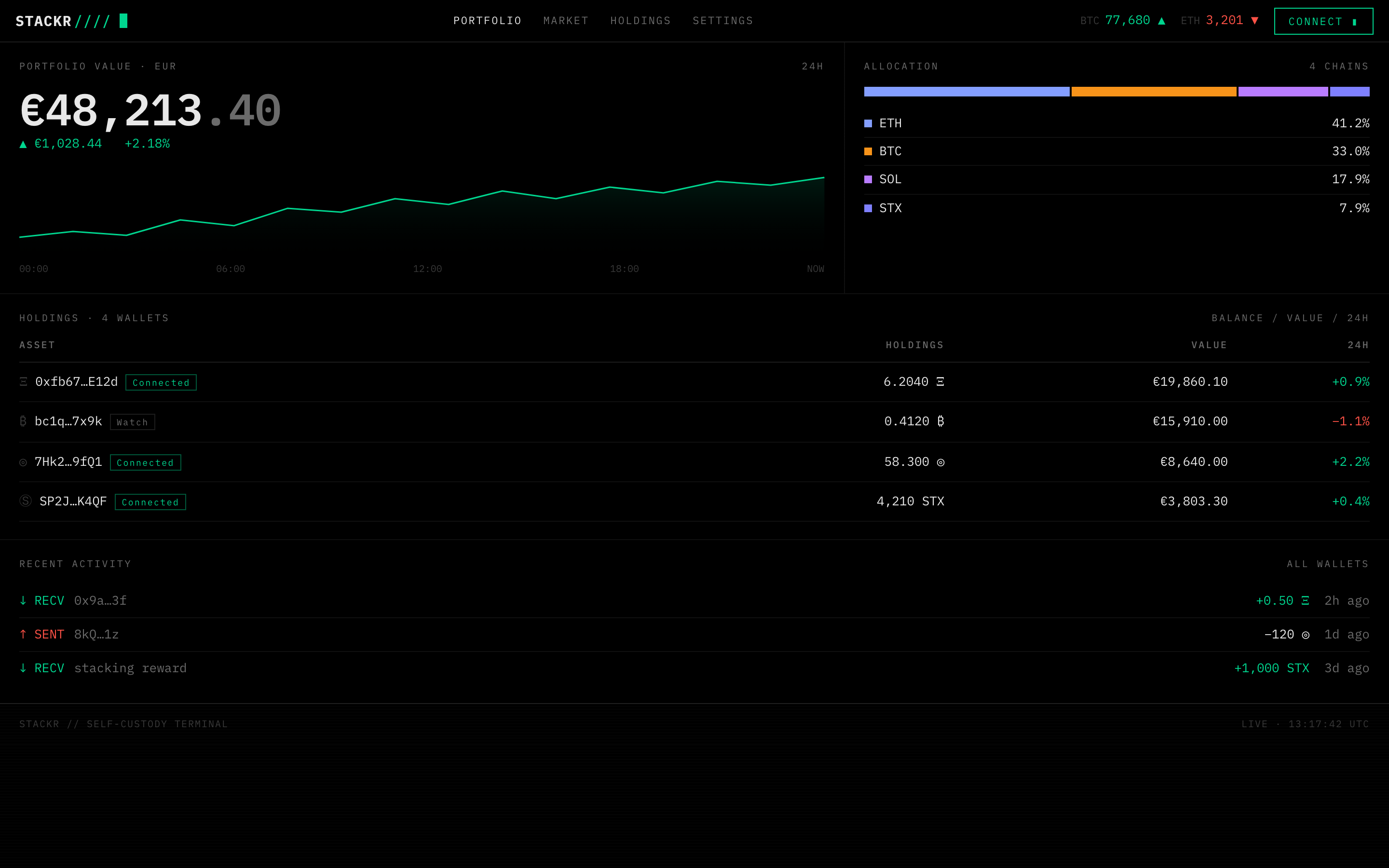
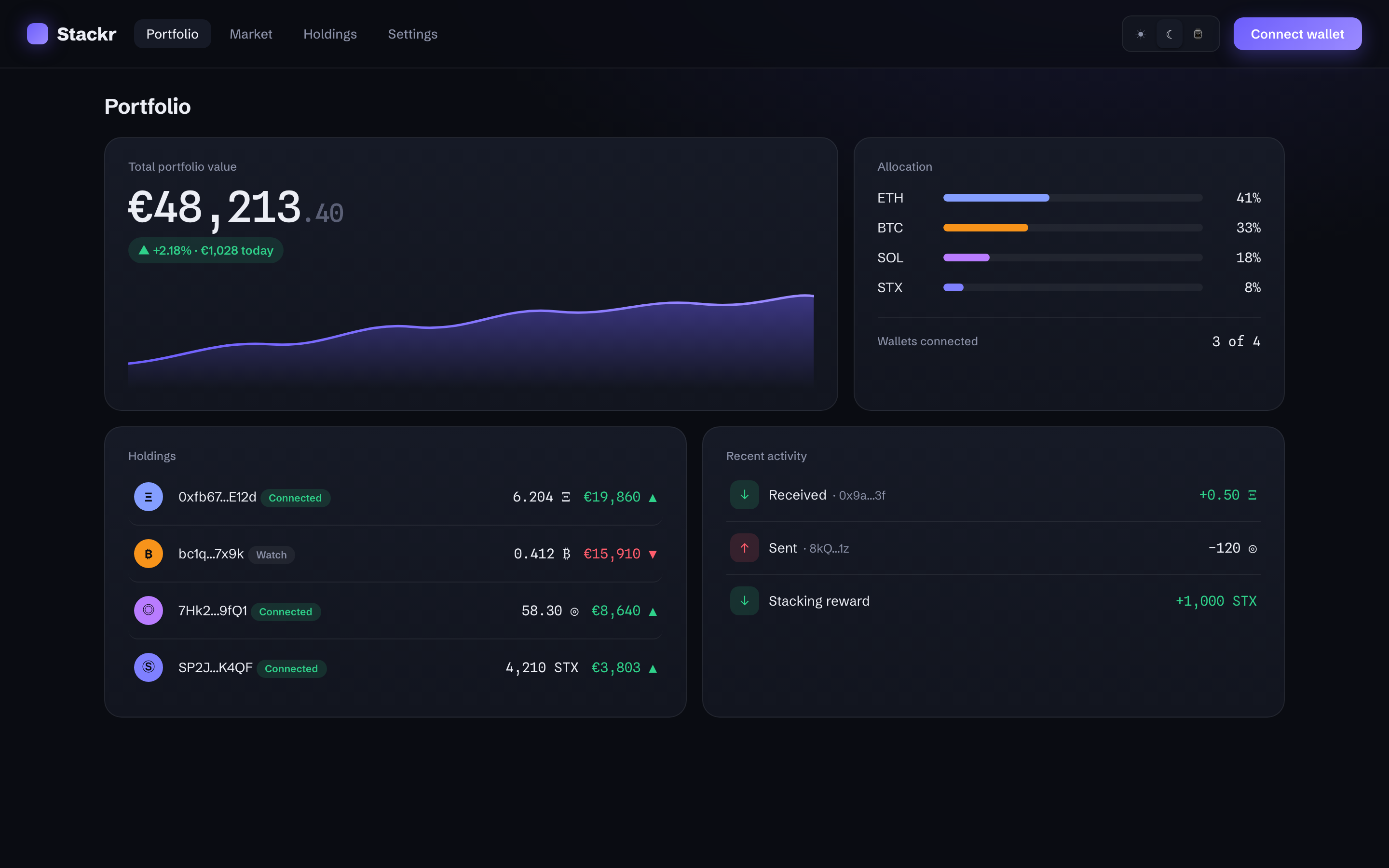
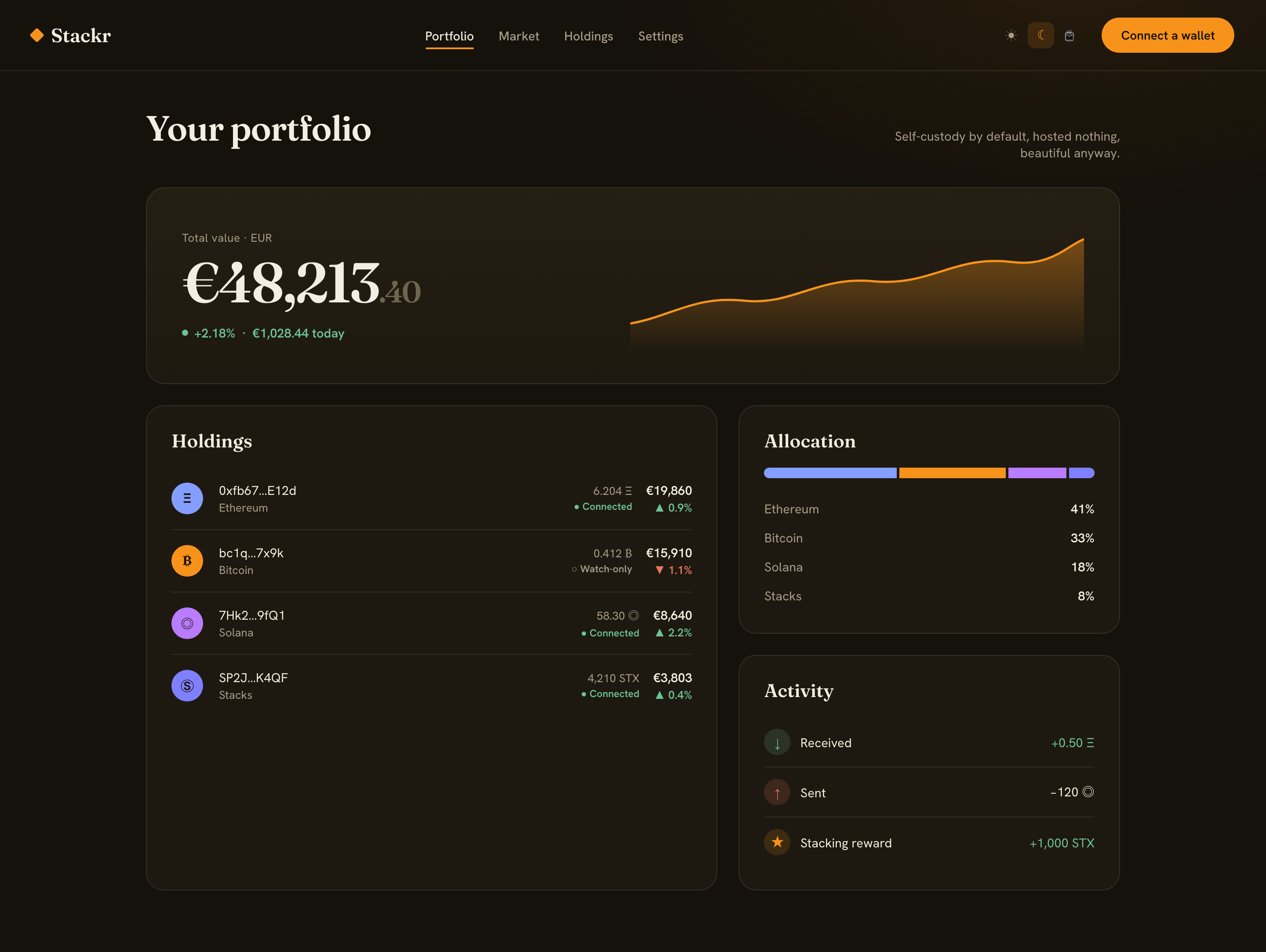
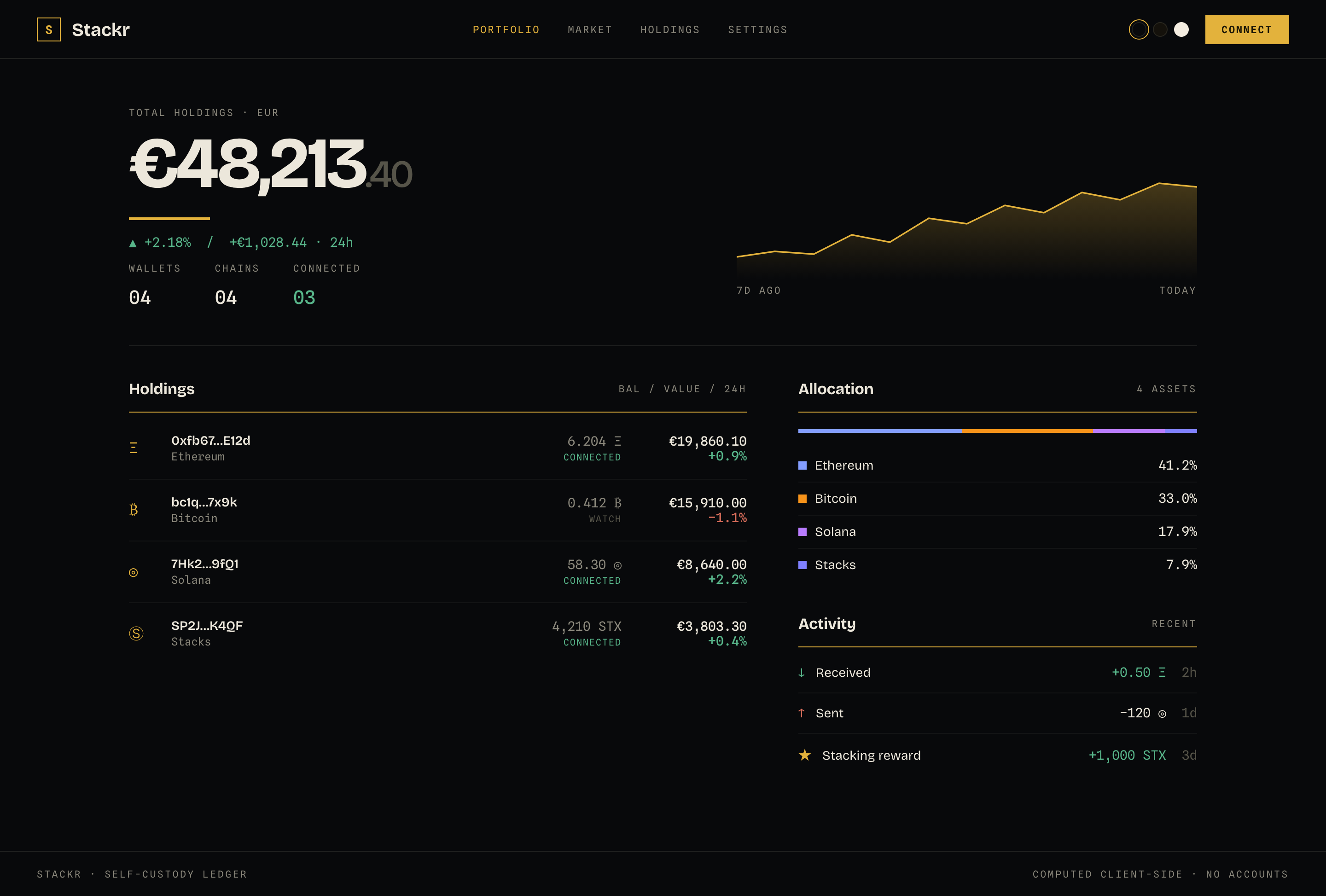
I shipped Terminal. It’s the most honest expression of what Stackr is — a fast, dense, self-custody trading surface — and the hardest to mistake for a template.
What I built
Multi-chain, additively
The data layer is four read-only HTTP clients (BTC via Blockchair, ETH via Etherscan, SOL via Helius, STX via Hiro), each taking an address and returning a normalised balance. Wallet-connect is an additive layer on top: MetaMask via wagmi/viem, Phantom via the Solana wallet-adapter, Leather via @stacks/connect. A connected wallet is just a discovered address fed into the same pipeline as a watch-only one — so connected and watch-only holdings unify in a single portfolio view, and the service layer never had to learn about wallets at all.
Charts I own
The charts are custom SVG, not a library. A charting dependency re-renders the React tree on every tick; surgical <path d> updates on raw SVG handle 10+ updates a second without dropping frames. That was the right call for the order book and depth chart specifically — the same argument that held on Cryptowatch’s trading surface, where I’d made it before.
Hand-rolled, accessible, fast
No dashboard or charting libraries. Visual primitives are hand-built; behaviour primitives (dialog, dropdown, tooltip) use headless Radix styled by me, so accessibility isn’t hand-rolled and risky. Everything is keyboard-navigable with visible focus, direction is never colour-only, and the bar is Lighthouse 95+ across the board — which hand-rolled SVG and minimal JS reach comfortably.
Outcome
Stackr is live on Cloudflare Workers, serving the full four-chain experience from a single edge worker. The wallet-connect layer covers three wallet families plus watch-only addresses; the charts are mine end to end; and the whole thing ships with zero dashboard libraries. It’s a product I’m continuing to build — the terminal aesthetic above is where it’s heading.
Outcome
Live on Cloudflare Workers · four chains in one view · wallet-connect across three wallet families plus watch-only addresses · custom SVG charts built to hold 10+ ticks/sec without jank · zero dashboard libraries.