---
title: "Stackr: A Self-Custody Multi-Chain Portfolio Terminal"
description: "Stackr tracks balances, allocation, and activity across Bitcoin, Ethereum, Solana, and Stacks in one view, computed entirely client-side from public chain RPCs."
tags: ["Next.js 15", "React 19", "TypeScript", "Tailwind v4", "Custom SVG charts", "wagmi / viem", "Solana wallet-adapter", "@stacks/connect", "Turborepo", "Cloudflare Workers"]
canonical: https://petewatters.ie/work/stackr/
source: https://petewatters.ie/work/stackr.md
---
# Stackr: A Self-Custody Multi-Chain Portfolio Terminal
## Overview
Stackr is a cross-chain portfolio terminal for people who actually self-custody. Connect MetaMask, Phantom, or Leather, or paste any address to watch it, and your holdings across **Bitcoin, Ethereum, Solana, and Stacks** render in one view: balances, allocation, and recent activity, with live prices and depth-aware charts.
Everything is computed client-side from public chain RPCs. No account, no database, no tracking. It's a monorepo (Turborepo + pnpm) on Next.js 15 / React 19, styled with Tailwind v4 and a hand-rolled component set, deployed to Cloudflare Workers.
## The problem
Most multi-chain portfolio trackers force a trade-off: hosted convenience behind a KYC wall, or DIY self-custody with no useful interface. And the ones that exist mostly look the same: a generic dark dashboard, a stock charting library, a narrow centred column with oceans of empty space, color as the only signal.
I wanted the opposite: self-custody by default, hosted nothing, and a surface that feels like a real trading terminal: dense, fast, and recognisably built rather than assembled from a UI kit.
## Design exploration
Before committing, I built four full working design directions for the dashboard, using the same data and components across four distinct points of view, and put them side by side. Each is full-width and dense (no wasted space), accessible (direction conveyed by arrows and sign, not colour alone; AA contrast; real focus states), and hand-rolled. The only dependency added was web fonts.
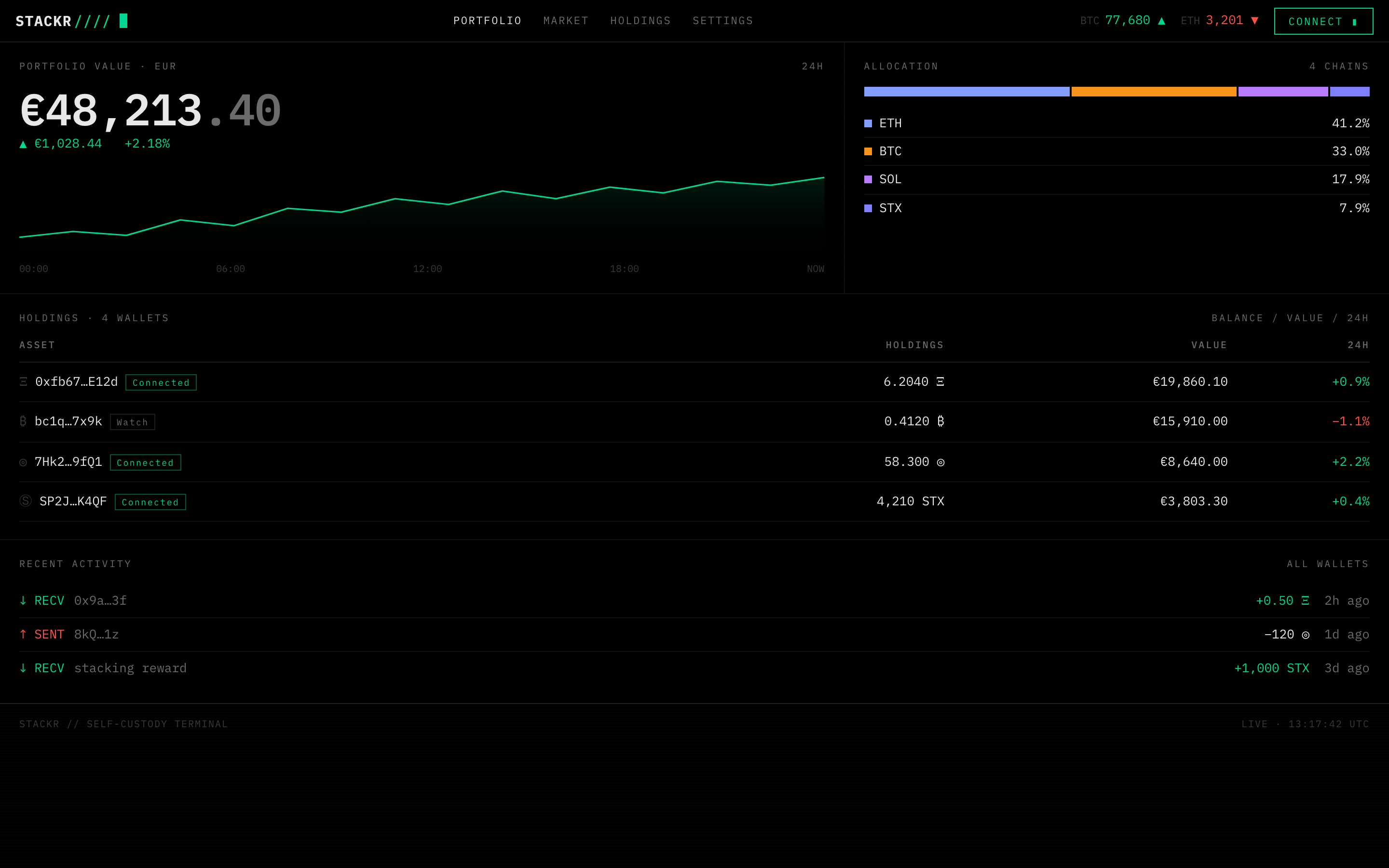
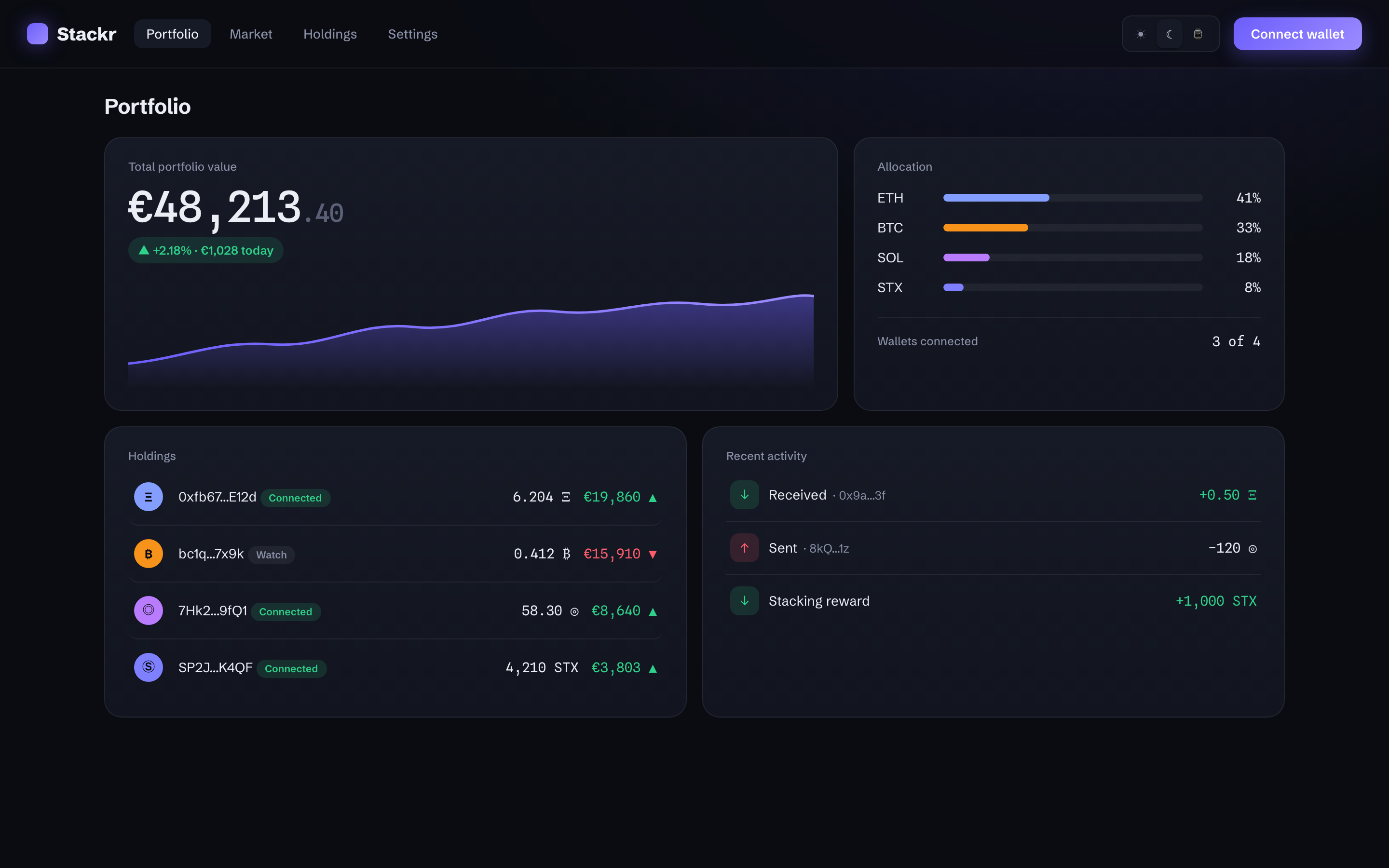
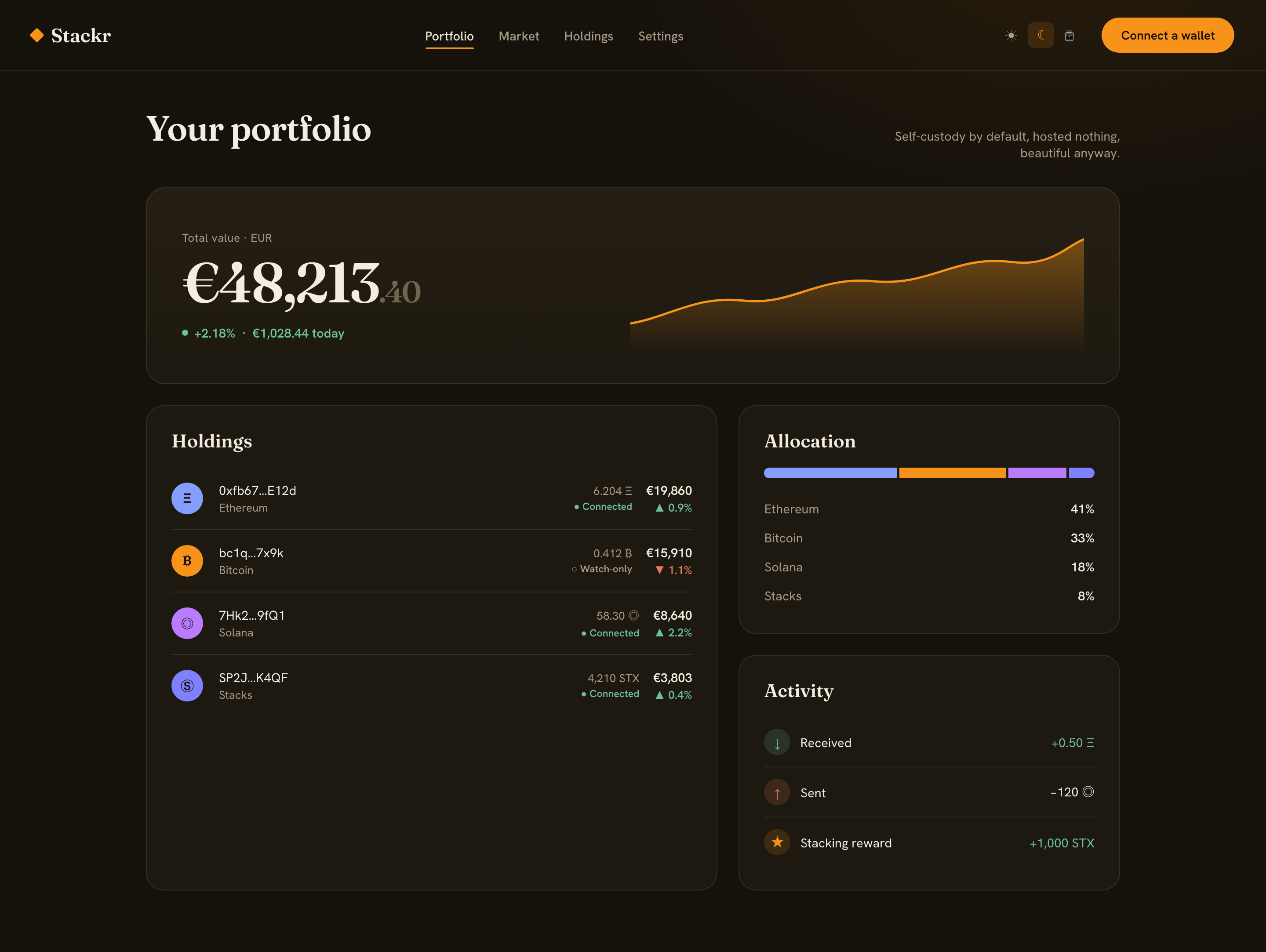
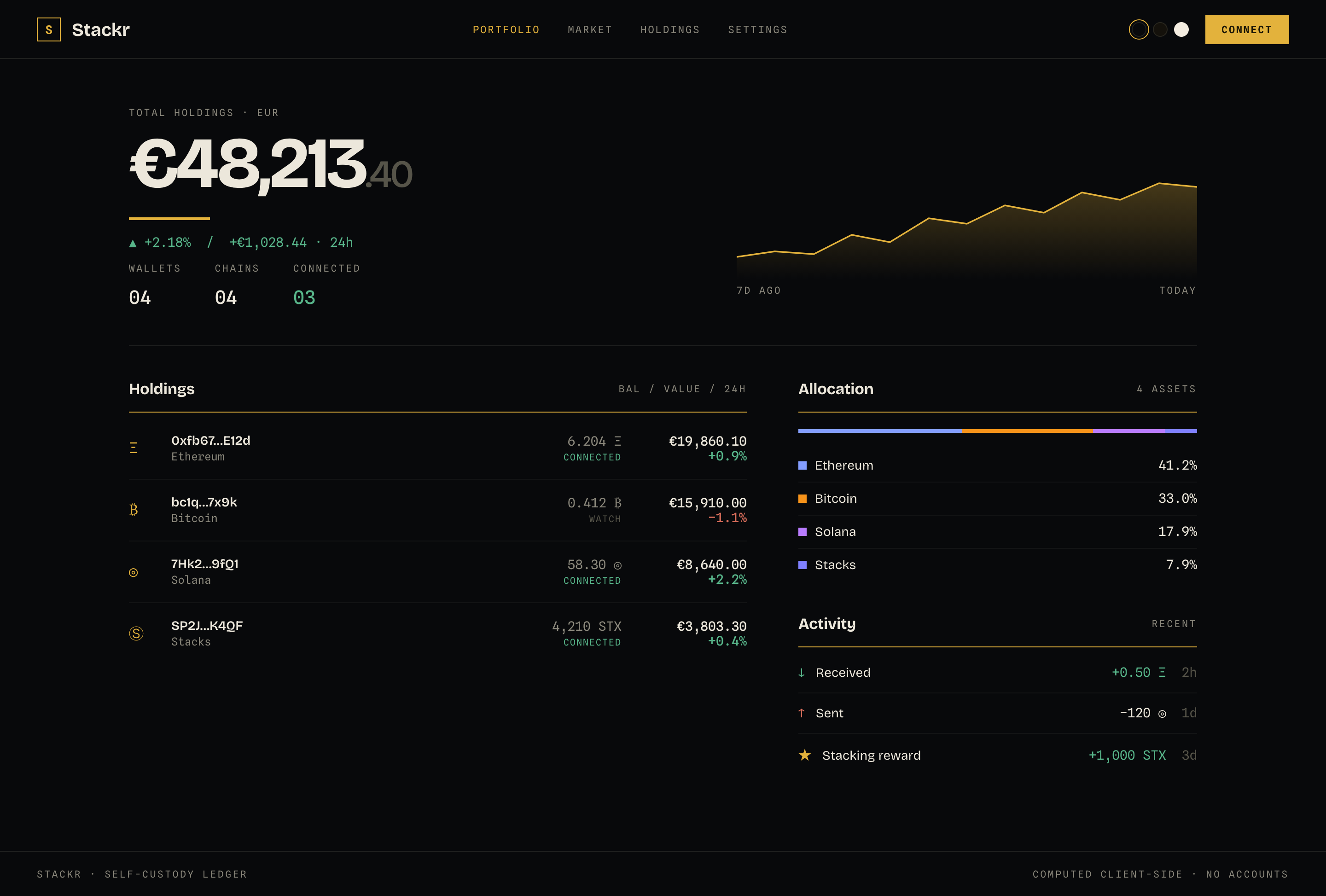
Direction A, Terminal: pure-black, all-monospace (IBM Plex Mono), dense number ladders, hairline grid, HUD chrome. The shipped direction, a Bloomberg-for-crypto feel.Direction B, Slate: deep slate panels, indigo accent, distinctive sans with tabular-mono numerals, soft elevation. Funded-product polish.Direction C, Leather Warm: warm near-black, Bitcoin-orange accent, Fraunces display serif, soft geometry. Editorial and human, a deliberate break from the cold-dashboard norm.Direction D, Onyx Ledger: near-black and gold, Bricolage Grotesque, ruled ledger tables. Terminal density with a quiet-luxury calm.
I shipped **Terminal**. It's the most honest expression of what Stackr is, a fast, dense, self-custody trading surface, and the hardest to mistake for a template.
## What I built
### Multi-chain, additively
The data layer is four read-only HTTP clients (BTC via Blockchair, ETH via Etherscan, SOL via Helius, STX via Hiro), each taking an address and returning a normalised balance. Wallet-connect is an **additive layer** on top: MetaMask via wagmi/viem, Phantom via the Solana wallet-adapter, Leather via `@stacks/connect`. A connected wallet is just a discovered address fed into the same pipeline as a watch-only one, so connected and watch-only holdings unify in a single portfolio view, and the service layer never had to learn about wallets at all.
### Charts I own
The charts are custom SVG, not a library. Each price update changes the `` attribute of the existing SVG instead of re-rendering a charting component, which keeps the order book and depth chart cheap to update.
### Hand-rolled, accessible, fast
No dashboard or charting libraries. Visual primitives are hand-built; behaviour primitives (dialog, dropdown, tooltip) use headless Radix styled by me, so accessibility isn't hand-rolled and risky. Everything is keyboard-navigable with visible focus, direction is never colour-only.
## Outcome
Stackr is live on Cloudflare Workers, serving the full four-chain experience from a single edge worker. The wallet-connect layer covers three wallet families plus watch-only addresses; the charts are mine end to end; and the whole thing ships with zero dashboard libraries. It's a product I'm continuing to build. The terminal aesthetic above is where it's heading.