One-person company: real-time, edge-served, crash-proof — built by directing AI across the whole stack
A real-time Fantasy Premier League product, built solo.
SimplyFPL is a faster, calmer, never-crashes alternative to the incumbent live-rank trackers. Edge-served from Cloudflare, tested like a team product, and built by steering AI across architecture, infra, design, and ops — with me reviewing and signing off every commit.
View source on GitHubOverview
Fantasy Premier League has around 11 million managers, and on a big gameweek they all want the same thing at the same instant: their live rank, right now. The established tools deliver the data but buckle under load and bury it in clutter — the peak moment of excitement is exactly when the site falls over.
SimplyFPL is my answer, built as a one-person company: be the fast, quiet, never-crashes alternative. Latest data first, nothing in the way, rock-solid precisely when everyone piles in at 5pm on a Saturday.
The genuinely interesting part isn’t fetching FPL data. It’s the operating question behind it: how does a single engineer ship a real-time, edge-served product with a team’s reliability — and keep moving fast? My answer was to build the infrastructure properly and to run an AI-driven development workflow where I direct the model, set the standards, and own every commit.
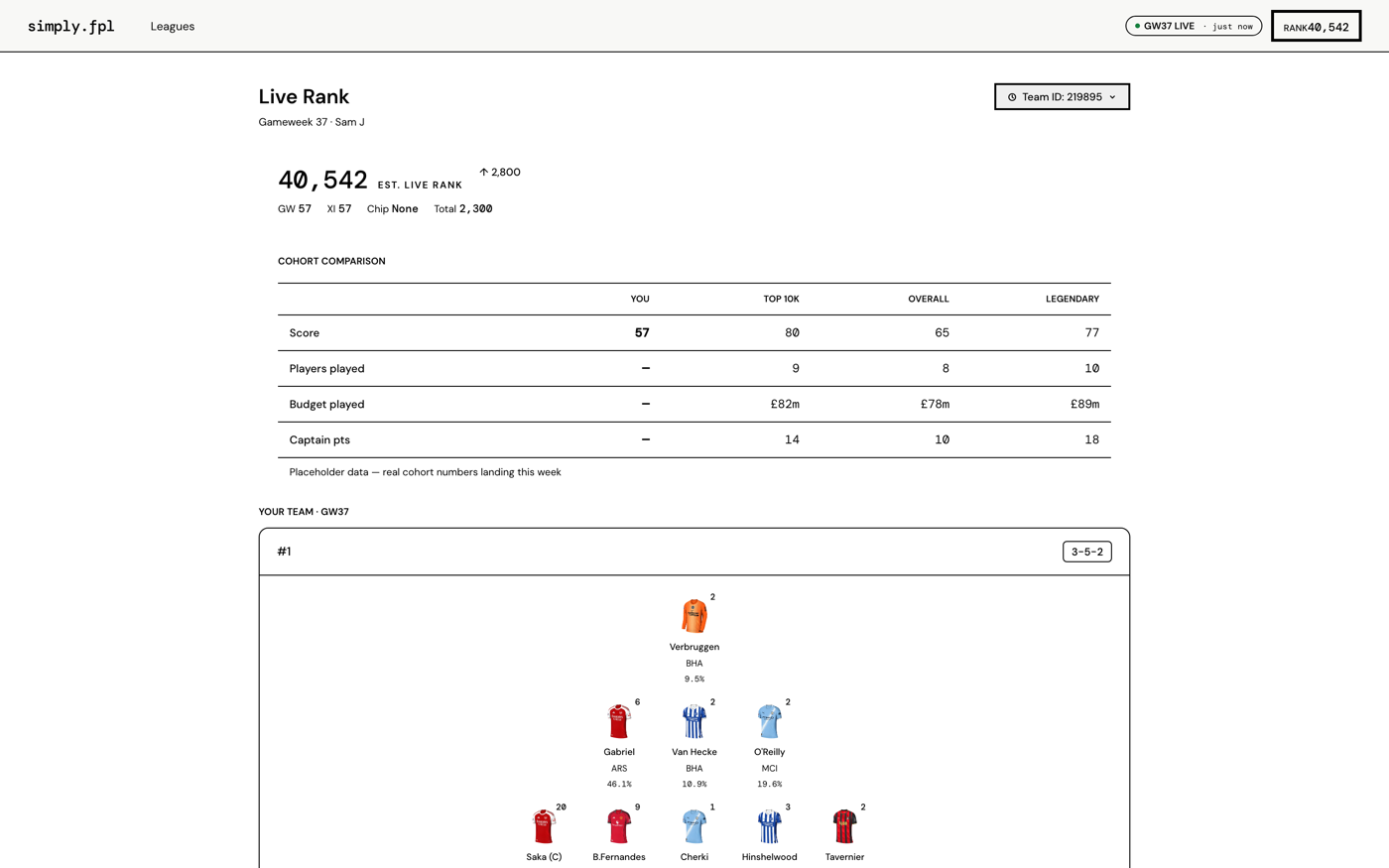
The problem
Three constraints at once:
- Reliability at the worst possible time. Live data is interesting only during matches, when traffic spikes hardest. A naïve design — every browser polling FPL every 60 seconds — is exactly how you crash and get rate-limited.
- Clarity under density. Managers want a lot of numbers, fast, without a wall of clutter. The brand is “cleaner than the incumbent,” so every element has to earn its place.
- A team’s surface area, a solo budget. Web now, native later, plus auth, payments, a price predictor, cohort analytics — the scope of a small team, the staffing of one person.
What I built
The architecture — a clean monorepo, edge-first
A Turborepo / pnpm monorepo organised in strict clean-architecture layers, so a solo codebase stays legible and the same logic powers web today and native tomorrow:
- Domain logic — pure TypeScript: the FPL client, live-rank and price-change algorithms. No React, no platform code, fully unit-tested.
- Application — React-aware business logic and hooks; the heart of the product, where coverage matters most.
- Presentation — one cross-platform component layer in Tamagui, and a thin Next.js shell that only composes and routes.
- Infrastructure — the Cloudflare Worker that fronts every FPL call.
Boundaries are enforced, not aspirational: types carry no logic, UI carries no business logic, apps depend on packages and never the reverse.
The hard part — real-time data at the edge
SimplyFPL inverts the naïve polling model:
- Every FPL request goes through a Cloudflare Worker with KV caching — never direct from the client. One upstream read fans out to thousands of users.
- A Durable Object owns the live gameweek: it computes the live snapshot once and fans it out over WebSockets to every connected client on a fixed cadence, with a graceful polling fallback when sockets aren’t available.
- A cohort engine aggregates ownership and effective-ownership by rank tier (top 1k / 10k / 100k / overall), turning raw picks into the “what are my rivals doing” insight that makes the product sticky.
- A price-change predictor runs on the same edge infrastructure.
The result: load is decoupled from the number of users, the expensive work happens once, and the failure mode that defines the competition simply doesn’t exist here.
The gameweek simulator
The killer constraint of building anything live for football: the matches only happen when they happen. You can’t test live-rank behaviour, fan-out, or intra-gameweek edge cases on a Tuesday in the off-season.
So I built a gameweek simulator into the worker — a replay engine that re-runs a real gameweek’s data through the live pipeline deterministically. It lets me develop and debug live features on demand, reproduce a specific minute of a specific gameweek to chase a bug, and run a full match-day’s worth of state transitions in seconds, in CI, with no live dependency. It’s paired with a season-archive routine that captures the complete season before FPL wipes the prior year each August — preserving real data to simulate against indefinitely. For a solo team, that’s the difference between “wait until Saturday to find out” and “reproduce it now.”
The AI-driven workflow — and why I still own every commit
SimplyFPL is a deliberate experiment in AI-driven product development: how far one engineer can take a real product by treating AI as a force multiplier across the entire stack, while keeping full ownership of the decisions and the code.
The leverage is in the setup, not in “AI writes code”:
- I work primarily in Claude Code, Anthropic’s agentic CLI, as my development environment — pairing on architecture, infra, tests, and refactors across the monorepo.
- I steer it with a committed
CLAUDE.md— a written “constitution” for the repo that encodes the clean-architecture boundaries, naming and code-style rules, testing requirements, branching/release process, and hard guardrails. The model works within my standards instead of inventing its own, and every session and automated agent inherits the same rules. - I used Claude Code’s frontend-design plugin to run a structured design audit and generate three fully-realised redesign directions as working prototypes — compressing days of exploration into an afternoon (more below).
- The work is driven by a populated issue board and a set of RFCs — live fan-out, the rivals view, the cohort engine, the gameweek simulator — so the AI is always working against a clear, written spec rather than vibes.
- Repetitive and time-bound work runs as scheduled agents: season capture, gameweek simulations, and PR triage execute on a cadence without me babysitting them.
The crucial part for me: I review and sign off on every change, and every commit is authored by me. The AI is the throughput; the architecture, the trade-offs, the product calls, and the quality bar are mine. That ownership is the point — it’s what turns “AI wrote some code” into “I shipped and stand behind this product.”
Reliability engineering
Robustness is a feature, so it’s tested like one:
- BDD throughout — Gherkin specs with executable step definitions describe user-observable behaviour; every new feature ships with at least one scenario, with all network mocked so no test touches live FPL.
- End-to-end + visual regression — Playwright drives real routes. After a styling regression once took production down, visual-regression and page-error assertions became mandatory release gates: a blank screen now fails CI instead of reaching users.
- Disciplined delivery — GitFlow, conventional commits, pre-commit/pre-push hooks, and CI checks (format, lint, typecheck, tests, deploy) on every change.
Designing it
The visual identity is a Linear-inspired, information-first design system — warm-neutral palette, monospace for every number to signal “this is data,” borders not shadows, restrained motion — built once in Tamagui and shared across platforms.
Most recently I ran a structured design audit (UX, hierarchy, and WCAG-AA contrast) and used the AI frontend workflow to explore three redesign directions in parallel — each a working prototype with both a pre-team landing and a consolidated, above-the-fold dashboard. The goal: make the live rank unmissable and bring rank, key stats, and the pitch together, even on mobile.
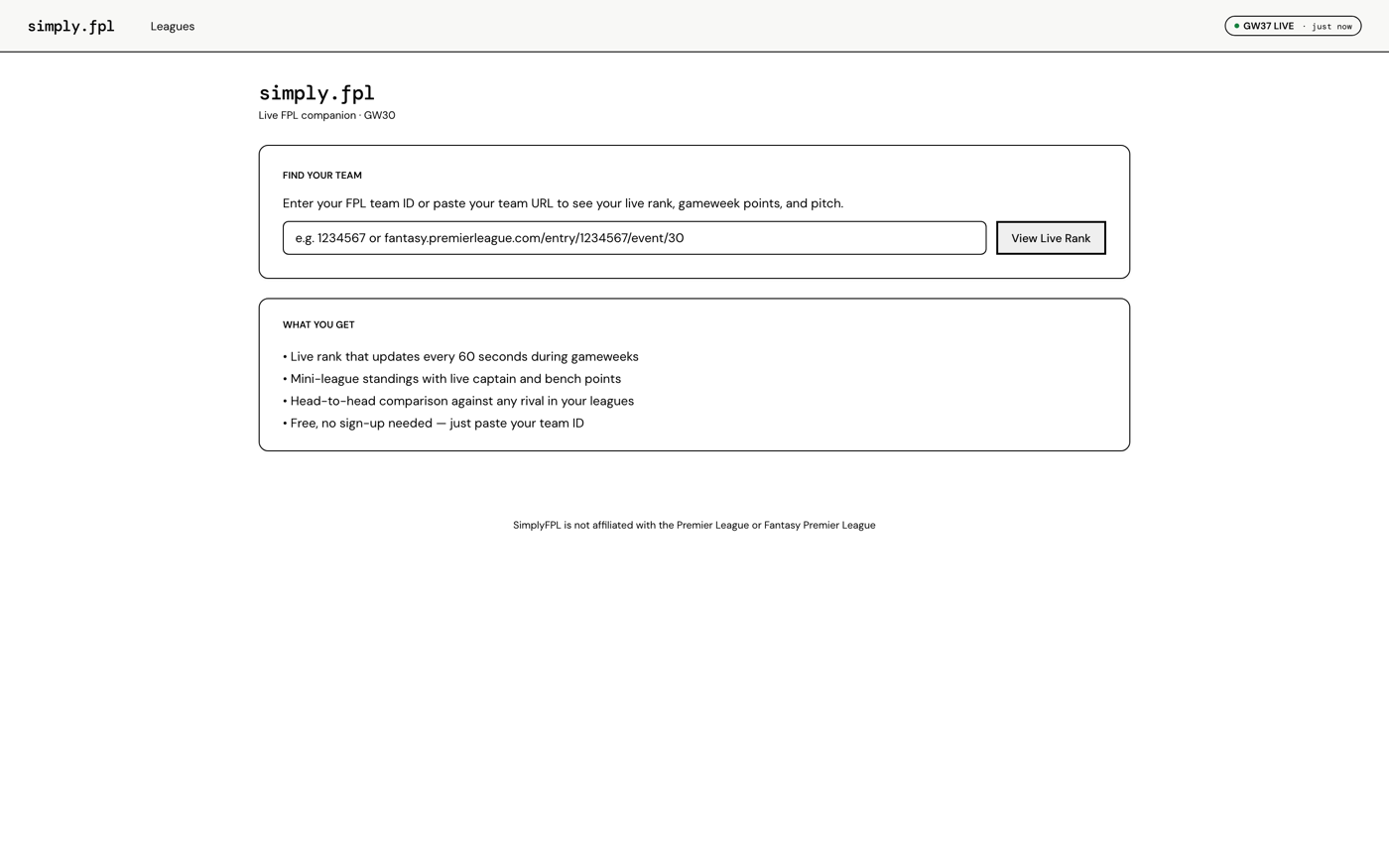
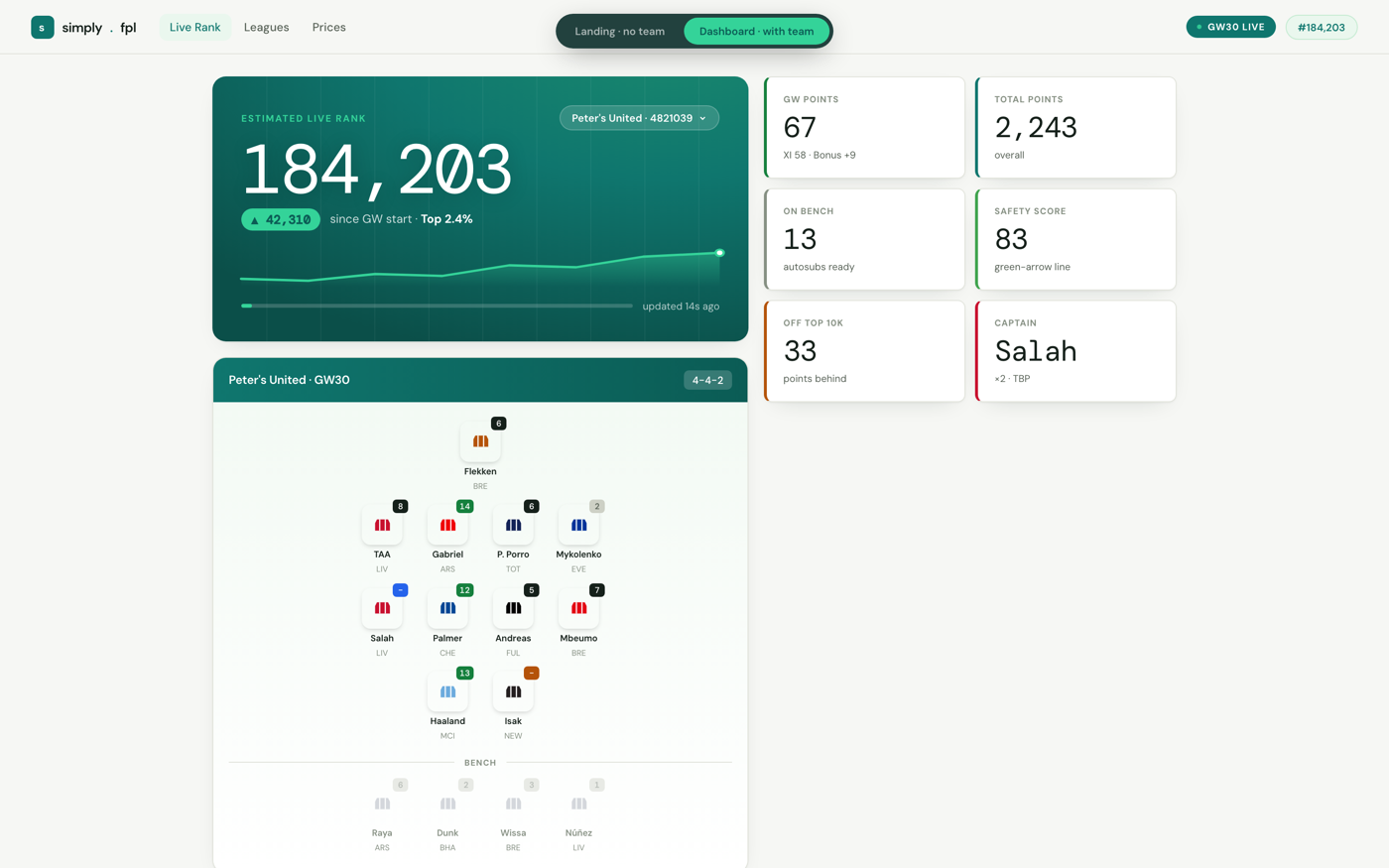
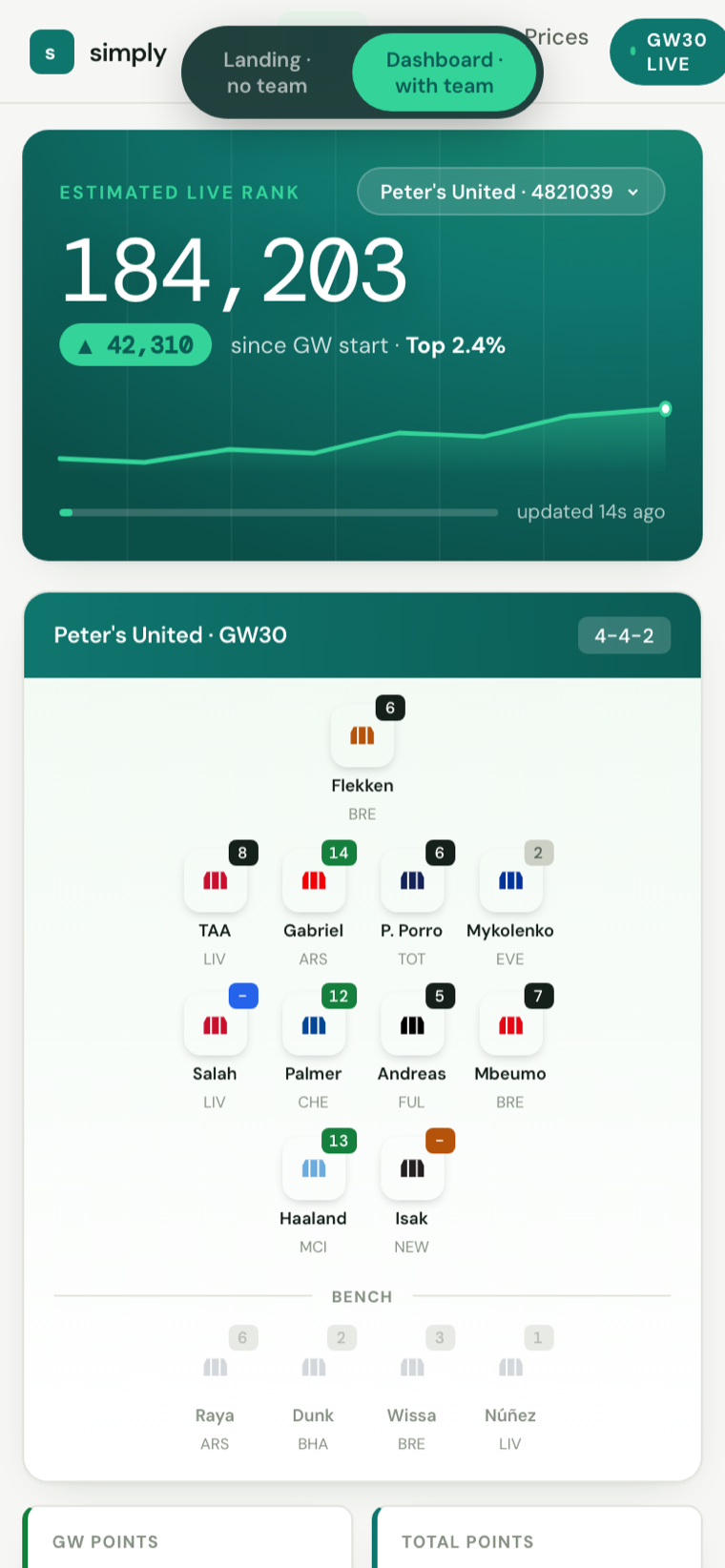
[Optional: drop in the after-A / after-B variants to show the full exploration, and any extra shots once available.]
Outcome
A real-time, edge-served product with a reliability model the incumbents lack, a clean cross-platform codebase one person can keep moving fast in, and tooling — the simulator and season archive — that removes the off-season as a blocker.
More than that, it’s a working answer to a question I care about: with the right setup — a written constitution for the codebase, a clear issue board, and AI as a force multiplier I direct and review — one engineer can ship and fully own work at the scale of a team.
Next: mobile app via Expo, the Pro tier, and a public launch before the 2026/27 season kicks off.
Outcome
- 1
- Person — architecture, edge infra, design system, tests, and ops
- 60s
- Live-rank refresh, fanned out to every client from one edge compute
- 100%
- FPL traffic served through the edge — client load decoupled from upstream
- 3
- Redesign directions explored in a structured AI-assisted design audit
A real-time, edge-served product with a reliability model the incumbents lack — and a working model for how one engineer, directing AI deliberately, can ship and own team-scale work.